
Understanding Solar Inverter Types

String Inverters (Central)
The traditional and most common choice. A single, powerful unit manages the energy output for a group (string) of panels.
Cost: Most affordable upfront.
Efficiency: Good, but entire string output is limited by the lowest performing panel (shade, debris).
Monitoring: Typically system-level only.
Best For: Unshaded, simple rooftops.

Microinverters
These small devices are installed directly underneath each individual solar panel, converting DC to AC at the panel level.
Cost: Higher upfront cost.
Efficiency: Maximum energy harvest. If one panel is shaded, the others are unaffected.
Monitoring: Panel-level performance tracking.
Best For: Shaded or complex rooftops; systems that require maximum reliability.

Hybrid Inverters
A string inverter that is also capable of managing and charging a solar battery, acting as a hub for both the grid and storage.
Cost: Mid-to-high, but saves cost on a separate battery charge controller.
Efficiency: Optimized for battery integration (DC-coupling).
Functionality: Essential for home battery storage and backup power.
Best For: Homes planning for battery backup/storage now or in the future.

Smart Home Inverters
AI-driven devices that integrate with home automation to optimize real-time energy flow between panels, appliances, and the grid.
Cost: Mid-range to premium investment.
Efficiency: AI-optimized; prioritizes power for essential devices during peak hours.
Functionality: IoT-enabled app for whole-home energy tracking.
Best For: Tech-savvy users with smart appliances seeking total energy management.
Inverter Comparison Summary
| Feature | String Inverter | Microinverter | Hybrid Inverter | Smart Home Inverters |
|---|---|---|---|---|
| Efficiency | 92% | 95% | 96% | 98% |
| Battery Support | No | No | Yes | Yes (Lithium) |
| Monitoring | Manual | Panel-level | App-based | IoT + AI |
| Best For | Budget homes | Shaded roofs | Backup power | Smart homes |
| Warranty | 5 Years | 7 Years | 7 Years | 10 Years |
Efficiency & Benefits
Efficiency & Savings
High Conversion: Reduce energy loss, maximize savings.
Lower Bills: Save up to 30–40% annually.
Eco-Friendly: Cut carbon footprint.
Smart Features & Incentives
Monitoring: Track performance via mobile app.
Subsidies: Eligible for local/state incentives.
How to Choose the Right Inverter
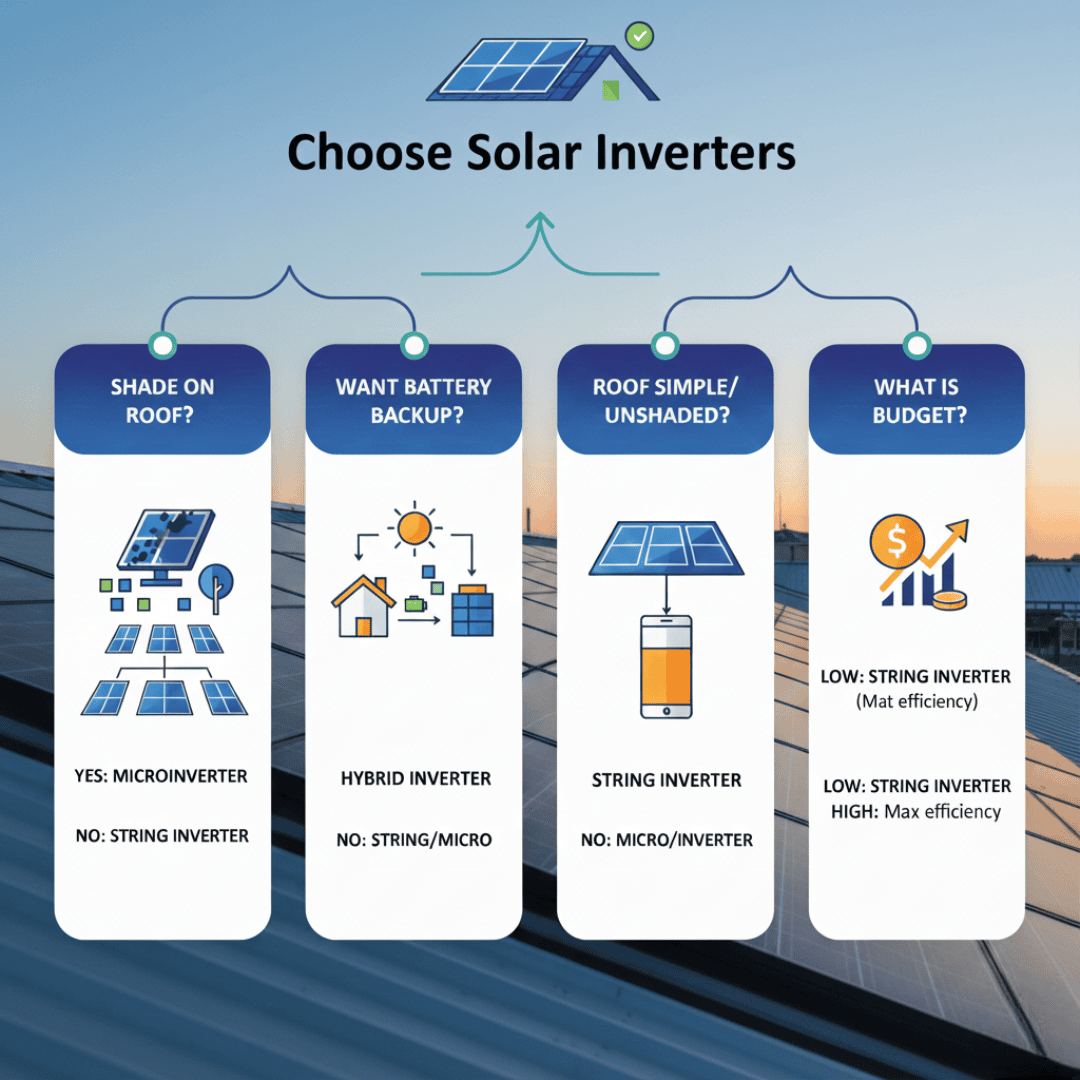
Your ideal inverter type depends on your home's specific conditions and future energy goals. Consider these key questions:
Do you have any shade on your roof? If trees, chimneys, or neighboring buildings cast shadows on your panels at any point of the day, a Microinverter or an optimizer-paired String/Hybrid system is essential to maximize energy production.
Do you want battery backup (or plan to add it later)? If yes, a Hybrid Inverter is the most streamlined and cost-effective choice for integrating battery storage.
Is your roof simple and completely unshaded? If your roof faces one direction and has no shade issues, a traditional String Inverter offers the best value.
What is your budget? If upfront cost is the primary concern and shading isn't an issue, the String Inverter is the winner. If efficiency and panel-level control are priorities, the investment in Microinverters is justified.